
.png)

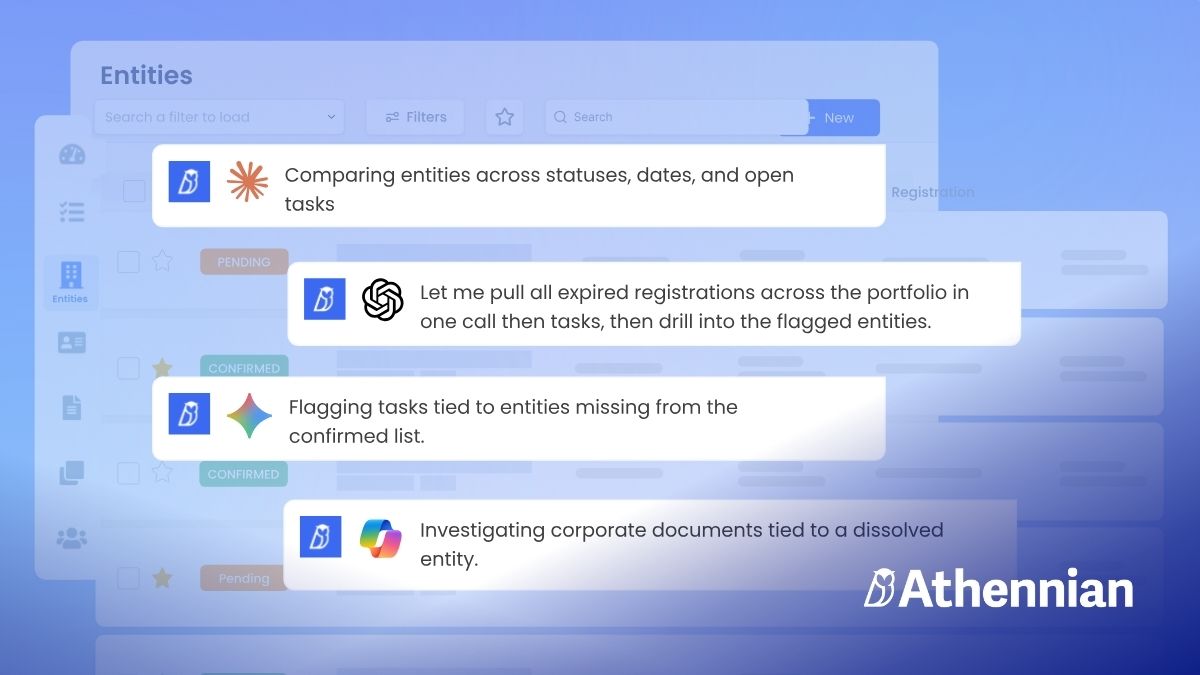
A governance request can sound simple: Prepare this group for transaction diligence.
Actually completing it can involve tracing an ownership structure, reviewing records across multiple entities, checking registrations and open tasks, finding missing documents, identifying inconsistencies, and organizing everything for review.
With Athennian MCP, that work can start with one prompt.
Athennian MCP connects the governance data in Athennian directly to AI tools like ChatGPT, Claude, Gemini, and Copilot. Give the AI the job you need done, and it can retrieve the Athennian information you are authorized to access, work through the steps, and return the result.
In one Athennian entity-audit example, a single request triggered roughly 20 discrete steps behind the scenes. The AI retrieved entities, deduplicated information, checked for discrepancies, prioritized what it found, and produced an answer for review.
That is what we mean by Just One Prompt.
You can ask a complex governance question or describe a multi-step task in a single request. The AI can find the information it needs in Athennian and work through the task without requiring you to gather every record first or break the work into a long series of prompts.
What is Athennian MCP?
Model Context Protocol, or MCP, is an open standard that allows AI tools to connect to other systems and data sources.
Athennian MCP gives those tools a governed, read-only connection to Athennian.
From the AI tool where you already work, you can ask a question or give it a governance task. The AI can retrieve the entity data, ownership information, documents, registrations, people, tasks, and other Athennian information it needs to respond.
Athennian remains the source of truth. MCP gives the AI a way to use that information while it works.
What can you do with just one prompt?
The useful question is not how many records the AI can look up. It is how much of the job it can work through for you.
For transaction diligence, for example, you could ask:
“Prepare this group for transaction diligence. Starting from [Parent Entity], identify every entity in the ownership chain and flag missing formation documents, unresolved corporate tasks, expired registrations, incomplete minute books and ownership inconsistencies. Give me a prioritized remediation list.”
That single request can require the AI to follow an ownership structure, retrieve records across multiple entities, review documents and registrations, check open tasks, identify exceptions, and organize its findings.
Teams can use Athennian MCP to:
- Trace ownership and prepare KYC or beneficial ownership analysis, including identifying information gaps that prevent a confident answer.
- Review a group for transaction readiness and surface missing documents, unresolved tasks, expired registrations, or ownership inconsistencies.
- Find upcoming compliance obligations and related tasks across a portfolio.
- Audit entity records or minute books for missing, inconsistent, or incomplete information.
- Compare information in another document against Athennian and flag discrepancies.
- Use Athennian data to complete documents and forms.
- Create reports, tables, dashboards, and other outputs using capabilities available in the connected AI tool.
And those examples are only a starting point.
Athennian supplies the governance data, permissions, tools, and skills. The AI tool brings its own capabilities for analyzing information, working with files, generating outputs, and completing other tasks.
As tools like ChatGPT, Claude, Gemini, and Copilot improve, the range of work you can try with your Athennian data can grow with them. You can take advantage of new AI capabilities without waiting for Athennian to build a dedicated feature for every possible report, analysis, document, or workflow.
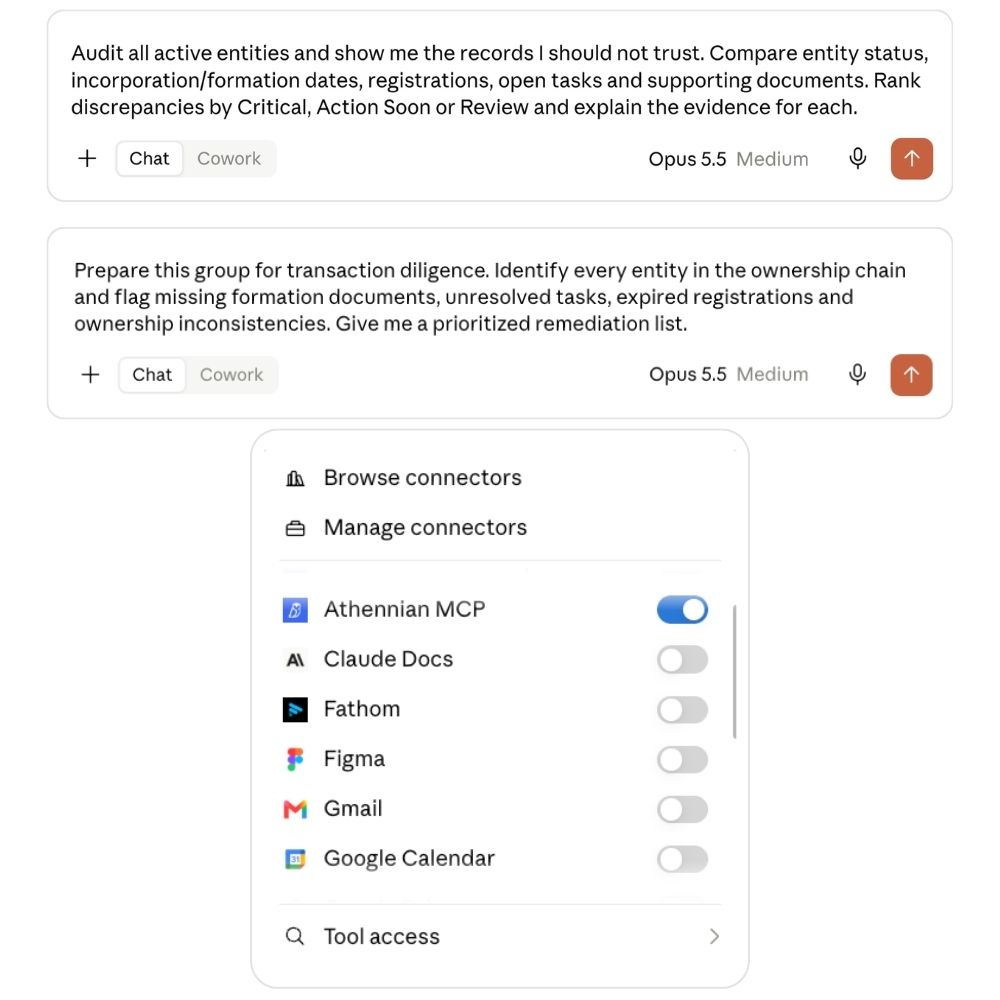
Work from live Athennian data
For AI to be useful in governance work, the information it works from matters.
An exported report or spreadsheet captures the data that existed when the file was created. If a registration changes, a task is completed, or a new document is added, that export does not update with it.
Athennian MCP lets the AI retrieve Athennian data when the request is made. It can also cite the Athennian sources it used so the user can review the records behind the answer.
That means your team can work with the information in Athennian without repeatedly exporting, uploading, and reorganizing files every time something changes.
AI still requires human judgment, particularly when accuracy matters. Athennian MCP gives the model current source data to work with and gives the user evidence they can review.
Use the same roles and permissions already in Athennian
Giving AI access to corporate information naturally raises the question of who can see what.
Athennian MCP uses the roles and permissions your organization already has configured in Athennian.
If a user can access registrations but cannot access minute books or committee information in Athennian, the AI cannot retrieve that restricted information through MCP either.
The same access boundaries apply when users work with Athennian data through their AI tools.
That makes it much easier to roll MCP out beyond a small group without creating a separate permission model for every user.
Keep Athennian as the system of record
Access is one concern. Protecting the underlying record is another.
Athennian MCP is read-only.
The AI can retrieve and work with Athennian data, but it cannot add, change, or delete information in the underlying entity record. Athennian remains the system of record.
Your team can use AI for research, analysis, document preparation, and other work without giving the AI permission to change the corporate record.
Get started with built-in prompts and skills
Knowing what AI could do is different from knowing what to ask it to do on day one.
Athennian MCP includes a library of prebuilt prompts and skills designed around governance work, so teams have somewhere useful to start.
The prompt library includes tasks such as cap table analysis, expiring registrations, year-end checklists, good-standing reviews, entity consistency audits, and roles and affiliation reporting.
Users can start with one of those prompts, adapt it to their own needs, or write their own as they become more comfortable with the product.
The skills work behind the scenes. When a request comes in, the AI can use an Athennian skill to understand the task, identify the appropriate Athennian tools, retrieve the relevant information, and work through the request.
So your team does not have to start with a blank chat window and figure out the perfect prompt. There are ready-made ways to begin using Athennian MCP for real governance work from the start.
See what your team can do with just one prompt. Request a meeting to explore Athennian MCP, see the built-in prompts and skills in action, and learn how to get your team connected.
.svg)




.png)


-p-500.webp)
-p-500.webp)
-p-500.webp)
.webp)
